


Case study of cooperation on the COPiK implementation for 3V Sp. z o.o.
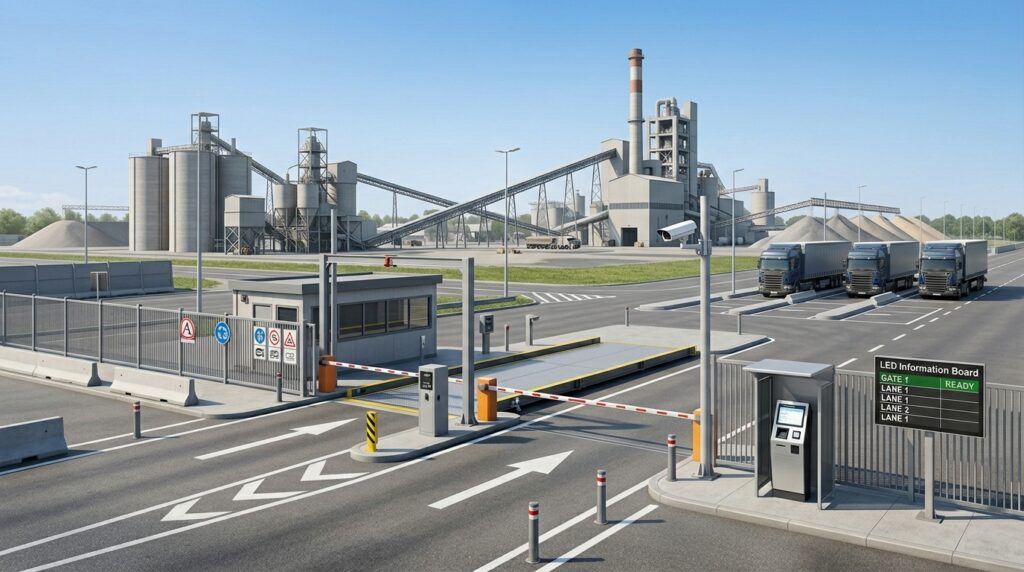
As a technology subcontractor for 3V Sp. z o.o., we took part in designing and implementing COPiK, a Digital Vehicle and Driver Check-in System. The solution was created for industrial plants, logistics centers, and facilities handling heavy vehicle traffic, where safety, traffic flow, and control over loading and exit processes are all critical.
Within the scope entrusted to us, we were responsible for a key part of the technology work: application delivery, client-server architecture design, hardware integrations, and support during the first live rollouts. In the end, the system covered the full vehicle journey: from driver check-in, queue management, and automated gate access to weighing, loading, exit, and document verification.
Business challenge
Before the implementation, vehicle traffic handling at the site was largely manual. In practice, this meant:
- queues of up to around 50 trucks waiting outside the facility,
- heavy workload for security staff and personnel responsible for managing traffic,
- a high risk of operational chaos caused by multiple product types and different loading points,
- delays during check-in and gate access,
- a greater risk of mistakes in weighing, loading, and document verification,
- limited event documentation and less control over the full process.
In facilities like these, the problem does not end at the gate. Vehicle flow must be synchronized with loading bay availability, health and safety procedures, weighbridge operations, and transport documentation. The end client needed a solution that would organize the entire process while remaining reliable in an industrial environment.
Project goal
The goal was not just to speed up vehicle entry into the facility, but to organize the entire vehicle handling process within one coherent system. This meant combining driver check-in, queue management, gate control, infrastructure integrations, and later verification of loading and weighing operations in one operational flow.
From a business perspective, the solution was meant to shift heavy vehicle handling from a manually coordinated process to one that was predictable, measurable, and scalable. At the same time, it had to reduce pressure on security staff, limit operational chaos, and improve control over what actually happens to each vehicle from check-in to exit.
How COPiK worked
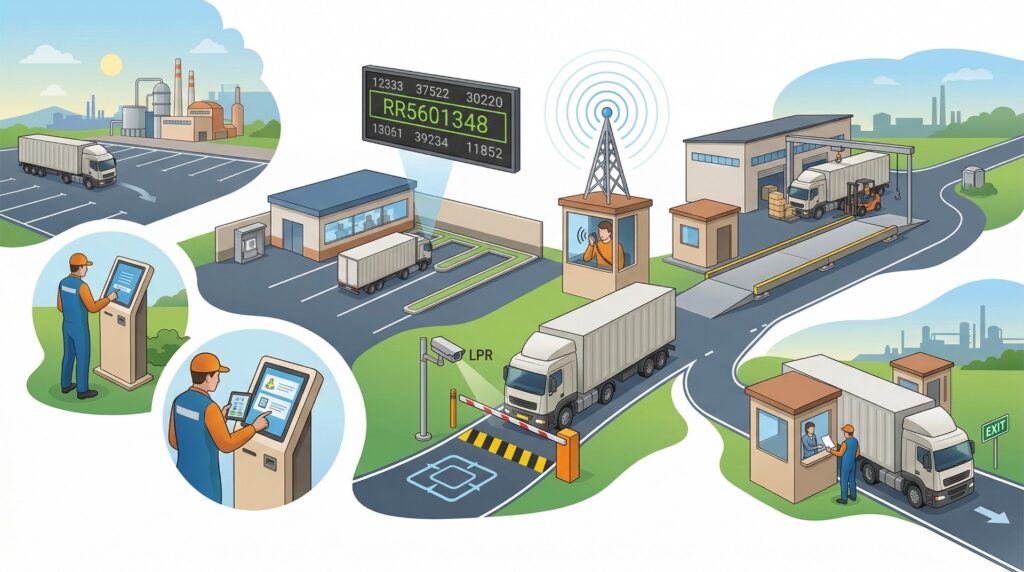
When a driver arrived at the parking area outside the facility, they no longer had to line up informally near the gate. Instead, they would go to a self-service check-in kiosk and begin the entry process there.
At the check-in station, the driver:
- selected the interface language,
- entered their basic details and vehicle registration number,
- selected the type of goods being collected or delivered,
- completed the required steps related to GDPR and health and safety procedures,
- confirmed possession of personal protective equipment such as a helmet, high-visibility vest, and safety footwear.
Depending on the site configuration, the system could also use additional peripherals such as document scanning and a breathalyzer. One part of the process also involved photo documentation. A camera capturing the driver’s full silhouette made it possible to verify whether the required protective clothing was being worn.
Once check-in was completed, the vehicle was assigned to the appropriate queue. This was especially important at facilities where different product types were handled at different loading points, for example separate positions for bulk materials and separate ramps for palletized or bagged goods. In practice, the system managed not one but several parallel queues.
Vehicles were called forward in two ways at the same time:
- by displaying the registration number on an LED screen,
- by broadcasting a voice message over a selected CB radio channel.
When the vehicle approached the gate, the system detected it using an induction loop and LPR cameras for automatic license plate recognition. If the vehicle had been checked in correctly and was in the proper queue, the barrier opened automatically. In exceptional situations, the driver could use an intercom, and the operator could intervene manually.
The next stages of the process also included weighbridge handling, tare measurement, linking the trip to the loading process, and later verifying consistency between operational data and transport documents or invoices. This meant the system supported not only gate entry, but also control over the entire vehicle handling cycle within the facility.
Scope of our work as a subcontractor
On the Asterisk-Dev side, as a technology subcontractor for 3V Sp. z o.o., we were responsible for an important part of the solution’s technical foundation. Our scope included:
- co-creating the concept of the system,
- designing the solution architecture,
- building the client-server application,
- implementing queueing and check-in logic,
- delivering interfaces for the kiosk, operator, and administrator,
- integrating LPR cameras, LED displays, CB radio, induction loops, intercoms, and weighbridges,
- integrating external systems and analytical modules,
- supporting rollouts and the post-launch hypercare period.
After the implementation phase, long-term support and maintenance remained with 3V Sp. z o.o.
Key technical challenges
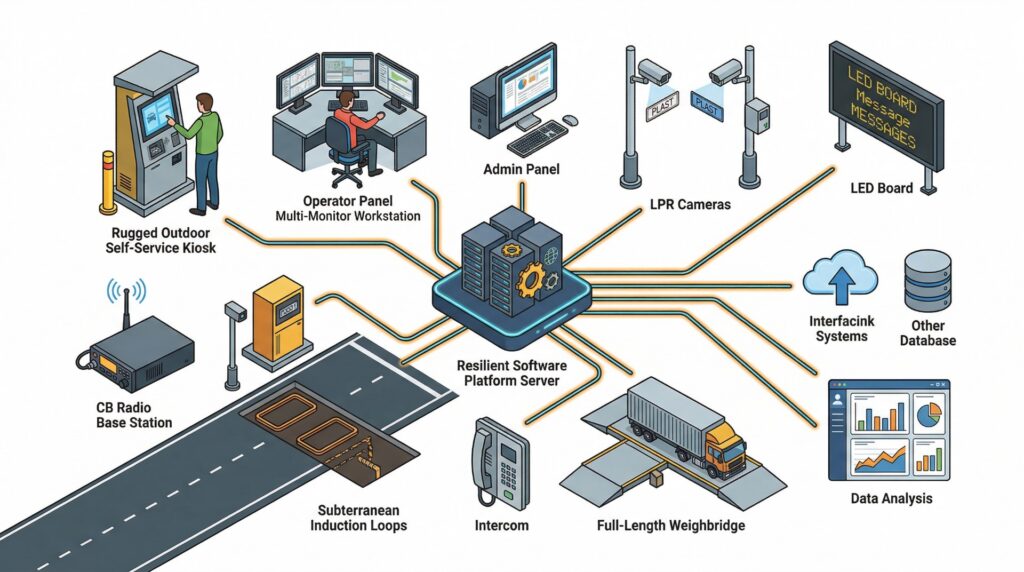
The biggest challenge was not building a single web application, but creating a reliable live system for an industrial environment while integrating multiple independent devices and data sources.
The most important technical aspects included:
- synchronizing many interfaces and devices within one local infrastructure,
- handling real-time communication instead of relying only on a classic HTTP request model,
- ensuring stable operation in locations with limited internet quality,
- reflecting real plant logic, including multiple queue types and many exception scenarios,
- connecting the software layer with hardware that directly affected vehicle movement and operational safety.
The system worked locally on-premise, which was important for business continuity at the facility. The analytical layer collected data from individual locations on a recurring basis, making it possible to analyze operational history and event data centrally.
Implementation results
The COPiK implementation organized the vehicle handling process and significantly reduced chaos at the facility entrance. From a business perspective, the key benefits included:
- faster and more predictable driver check-in,
- more structured vehicle flow even during peak traffic,
- fewer mistakes in weighing, loading, and document verification,
- more complete documentation of events, vehicle movements, and loading operations,
- better support for GDPR and health and safety compliance,
- reducing the number of people needed exclusively for queue and check-in handling to roughly one third of the previous level.
In practice, this meant moving from manually managing truck traffic on the yard to a digitally controlled process in which the operator supervised the situation from within the system instead of physically organizing the queue outside.
Why this project mattered
COPiK was a project where our subcontracting role combined classic web development with industrial automation, operational safety, and real-time hardware integration. That was the strongest differentiator of the implementation: the application was not just an administrative panel, but a central part of the process controlling vehicle movement within the facility.
From our perspective, it was also a strong example of cooperation where a clearly defined technology scope could directly improve work organization, operational costs, and the quality of driver and delivery handling. Projects like this show how custom software can organize complex logistics and industrial processes in places where off-the-shelf tools are too rigid or too shallow.


