



Case study
Enterprise Logistics Platform Case Study
For a client in the logistics and courier sector, we designed and built the entire platform from scratch, including both frontend and backend. The result is one operational core that connects with dozens of carriers and exposes a public API for clients and integration partners.
This was never meant to be a one-off integration. It was built as a high-availability platform that now supports:
- shipment and return creation,
- label retrieval and merging,
- parcel status monitoring,
- routing through carrier matrices,
- bulk imports and batch operations,
- settlement and reporting workflows.

Business Challenge
When you work with many carriers and many B2B customers, consistency becomes the biggest problem. Every carrier has its own API, data model, edge cases, and status lifecycle.
In this model, the platform acts as a logistics intermediary: collecting parcels from e-commerce and sales businesses, coordinating transport between stages, and then triggering last-mile delivery through the right carrier.
Without a unified system, this quickly leads to:
- unstable integrations and manual firefighting,
- delays in label generation and status updates,
- difficult scaling as shipment volume grows,
- high maintenance costs of many separate connections.
The objective was clear: build one stable logistics backbone that standardizes carrier communication and gives customers one predictable integration point.
Project Goal
Our task was to deliver a complete platform that:
- remains stable under growing shipment volume and customer load,
- automates repetitive operational work,
- allows fast onboarding of new carriers without major rework,
- gives operations teams better control and faster response,
- simplifies collaboration through one consistent API.
How The Platform Works
The platform runs on a cloud architecture powered by Firebase Functions, making it easier to scale as traffic and operational load increase.
At a high level, it is structured into four business-critical layers:
- a communication layer for clients and partners (API),
- a carrier integration layer,
- an automation layer for recurring operational flows,
- a monitoring and quality-control layer.
This setup supports multi-carrier operations today and makes future carrier onboarding much faster.
The public API was designed so sales companies can integrate quickly without having to manage each carrier’s technical differences.
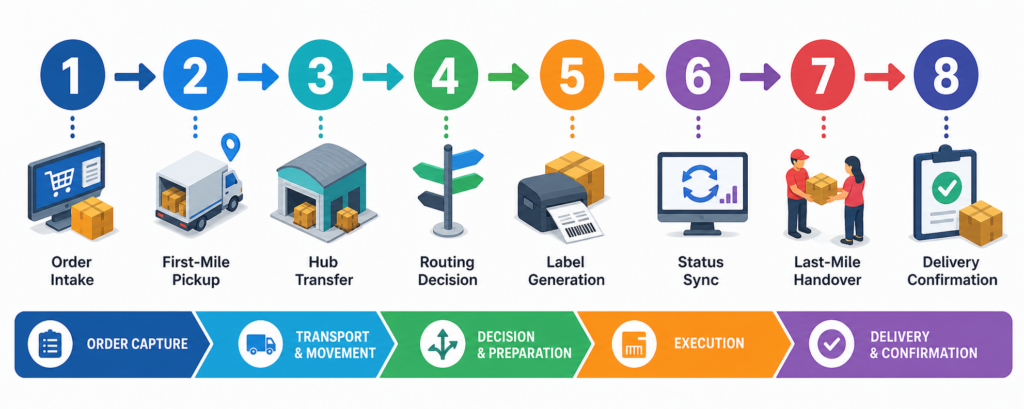
Scope Of Work
Our scope at Asterisk-Dev included:
- full platform architecture and domain module design,
- frontend implementation and operational panels,
- public API development for clients and partners,
- implementation and maintenance of carrier integrations,
- automated status and sales data synchronization,
- queue-based and batch-processing workflows,
- monitoring, metrics, and health checks,
- import/export and settlement module development.
Reliability Foundations
To keep the platform reliable at scale, we focused on:
- separation of critical flows from supporting processes to avoid full-platform disruptions,
- automated background processing to reduce manual workload and speed up handling,
- continuous monitoring and fast issue detection,
- fail-safe mechanisms and secure retries,
- centralized visibility of operational issues.
As a result, the system remains predictable even when external carrier services are slow or temporarily unstable.
Key Project Challenges
The hardest part was not exposing the API itself, but maintaining one consistent operational standard across very different carrier models.
The biggest challenges were:
- unifying multiple carrier cooperation models under one process,
- keeping operations smooth at high shipment volume,
- reducing the impact of external carrier errors on daily work,
- maintaining clear shipment visibility for both teams and end users,
- combining automation with cost and settlement control.
Business Outcomes
Instead of a patchwork of disconnected integrations, the client gained one central platform for logistics operations.
Key outcomes included:
- support for 100+ B2B sales clients,
- operational readiness for shipments across most European markets,
- stable handling of a growing seven-digit annual parcel volume,
- one consistent integration point for many carriers,
- more stable shipping, tracking, and label workflows,
- stronger automation of recurring and batch operations,
- faster onboarding of additional carriers,
- better observability and shorter incident-response times,
- lower per-parcel shipping costs for sales companies,
- centralized warehouse and shipping operations for the intermediary (operations module),
- centralized purchasing/sales settlement for courier services (settlement module).
System Evolution
The platform has been developed iteratively as business scale increased. From day one, it was treated as a long-term product, designed to expand with new features, new markets, and new integrations.
Why This Project Matters
This case shows what practical, business-focused high-availability logistics integration looks like: reliability, automation, and readiness for continuous growth.
The value does not come from one feature. It comes from an operational architecture that brings structure, reduces risk, and scales with the business.


